How Gravitational Waves Changed Our Understanding of Space
Einstein predicted them, doubted them and assumed we would never detect them. A century later we hear hundreds of cosmic collisions, have traced the gold in our jewellery to colliding stars, and are building an observatory millions of kilometres wide.
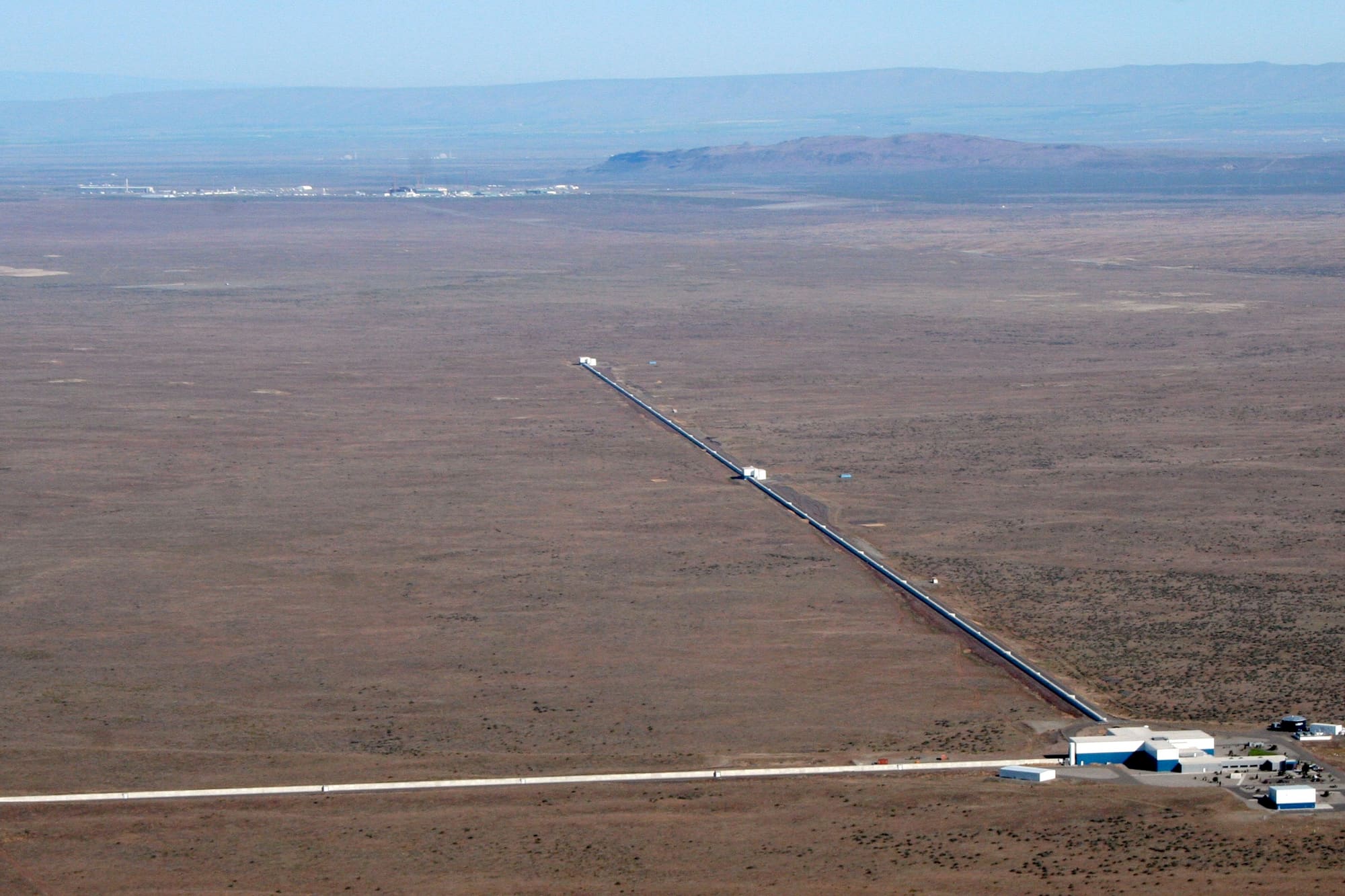
At 09:50:45 Coordinated Universal Time on 14 September 2015, a tremor passed through the Earth that nobody felt. It reached a laser observatory near Livingston, Louisiana, first, then, seven thousandths of a second later, its twin in the desert at Hanford, Washington. In each place, two four-kilometre arms of a giant L-shaped instrument changed length by a mere 4 × 10⁻¹⁸ metres, according to LIGO's own account, about one two-hundredth of the diameter of a proton.
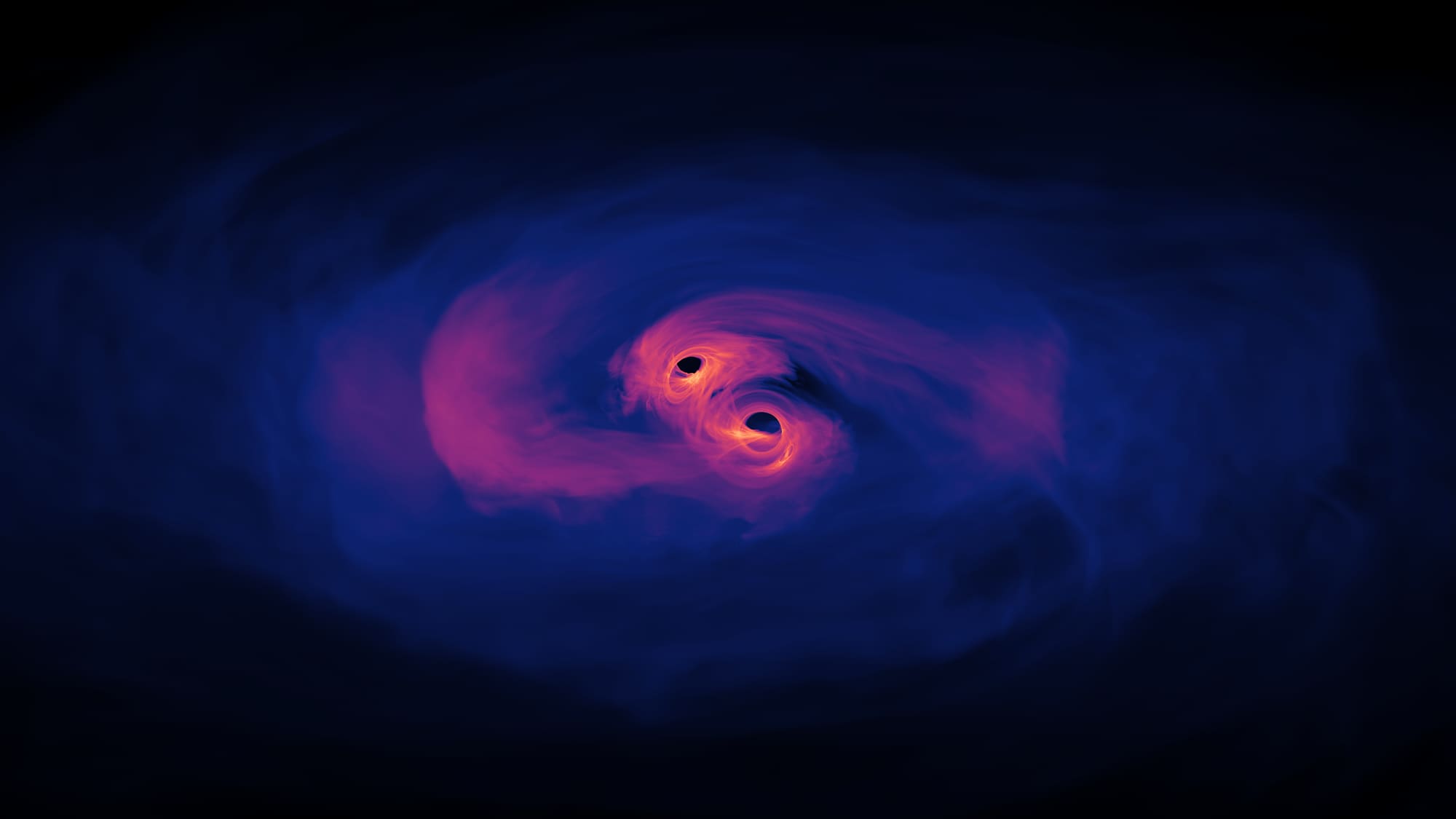
The tremor had been travelling for more than a billion years. It was a gravitational wave, a ripple in the shape of space itself, set off when two black holes spiralled together and merged. It lasted about a fifth of a second. Its arrival ended a hundred-year hunt, opened a new branch of astronomy, and changed how we think about the universe: not as something we only look at, but as something we can also listen to.
The prediction Einstein didn't trust
Albert Einstein completed his general theory of relativity in late 1915. Its central idea is that gravity is not a force pulling across empty space, but the curvature of space and time caused by mass and energy. If mass can bend spacetime, it seems natural that mass in motion should send ripples through it, the way a boat sends waves across a lake.
Einstein himself was not sure. In a letter to the astronomer Karl Schwarzschild in February 1916, he wrote that there were no gravitational waves analogous to light waves. Within months he had changed his mind, after a nudge from the Dutch astronomer Willem de Sitter showed him a way round a mathematical obstacle. In June 1916 he published a paper predicting the waves, then had to correct an error in it in 1918. Even in their corrected form, the waves he described were so feeble that detecting them seemed hopeless.
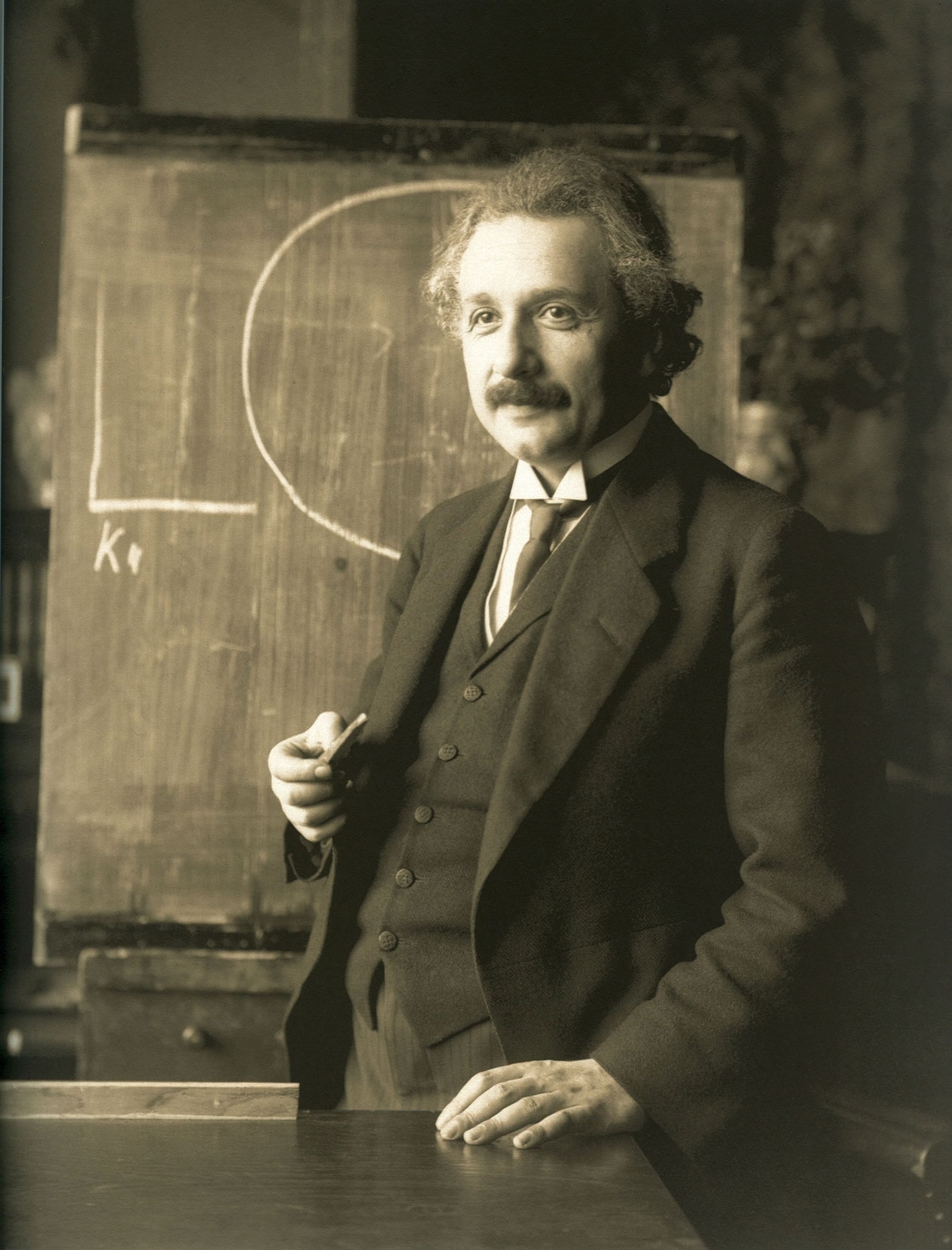
Twenty years later, his doubts returned. In 1936, working with his young collaborator Nathan Rosen, Einstein concluded that gravitational waves could not exist at all, and sent a paper saying so to the American journal Physical Review. The editor, John Tate, sent it to an anonymous referee, who returned a ten-page report explaining that the authors had been led astray by a poor choice of coordinates. Historians later identified the referee as the cosmologist Howard Percy Robertson.
Einstein was furious. He had sent the paper for publication, he told Tate, and had not authorised it to be shown to specialists. He withdrew it and never published in Physical Review again. Yet the referee was right. When the paper finally appeared, in the Journal of the Franklin Institute, its conclusion had been turned on its head: instead of proving the waves impossible, it described a new family of them. Robertson's conversations with Einstein's new assistant, Leopold Infeld, are often credited with the change of heart.
False alarms and a cosmic clock
The first person to go looking in earnest was Joseph Weber of the University of Maryland. In the 1960s he built detectors from solid aluminium cylinders about two metres long and a metre across, suspended on steel wires. A passing gravitational wave, he reasoned, would set a cylinder ringing at its natural frequency of about 1,660 hertz, and crystals around its waist would turn that vibration into an electrical signal.
In 1969 Weber announced that two bars, one in Maryland and another about 1,000 kilometres away at Argonne National Laboratory near Chicago, had recorded about two dozen coincident signals in 81 days. The next year he reported 311 coincidences in seven months, apparently pointing towards the centre of the Milky Way. It was electrifying news. Groups around the world built their own bars to check, and none found anything beyond random noise. By the end of the 1970s almost everyone but Weber had concluded the signals were spurious; their strength would have implied violent events happening nearby with implausible frequency.
Weber's claims fell, but his ambition did not. He had shown that the search was worth attempting, and he drew a generation of physicists into it.
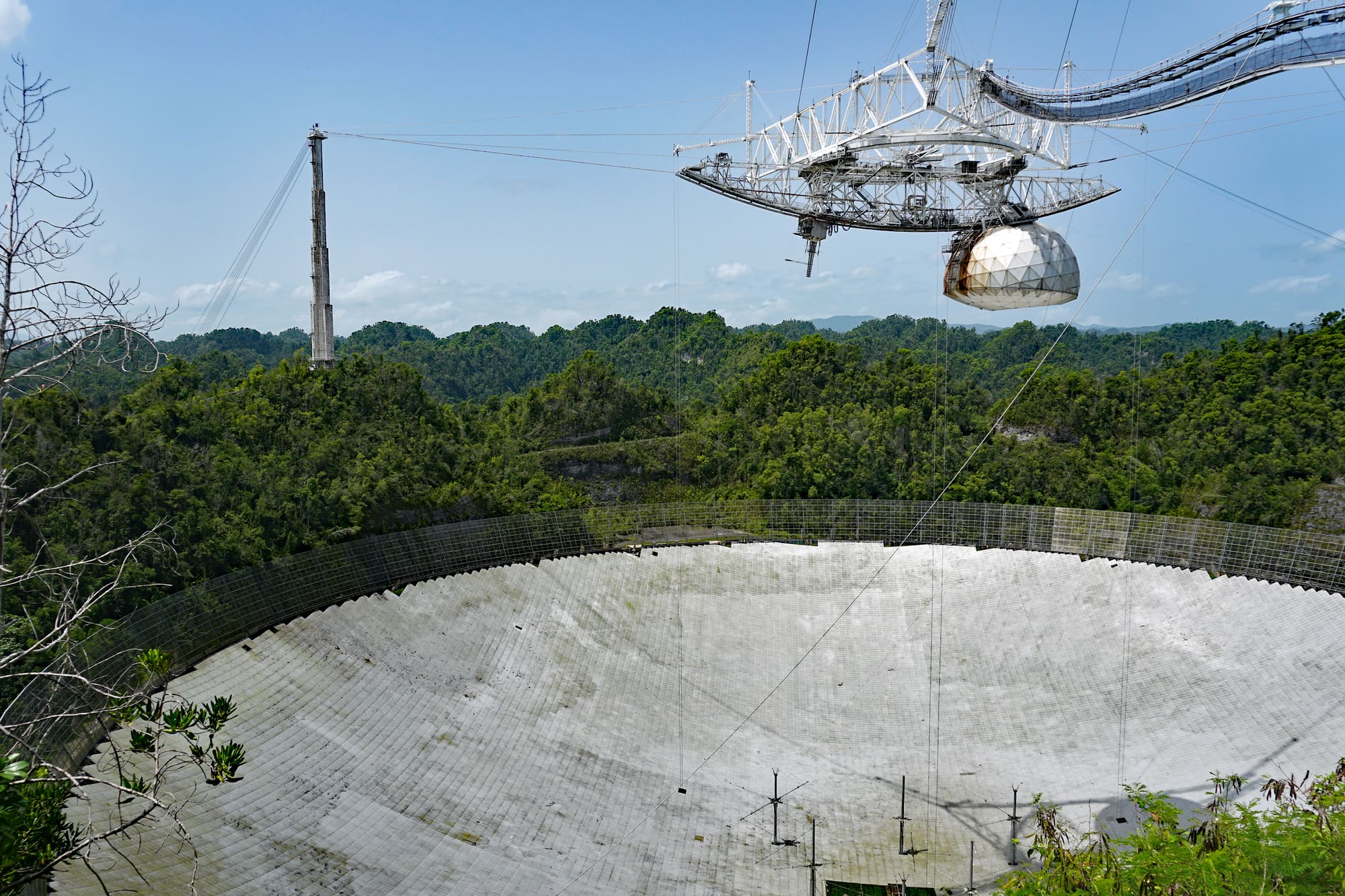
The first convincing evidence came not from a detector on Earth but from a pair of dead stars. In 1974 Russell Hulse and Joseph Taylor, using the 305-metre radio dish at Arecibo in Puerto Rico, discovered PSR 1913+16, the first known binary pulsar. A pulsar is a spinning neutron star that sweeps beams of radio waves across space with extraordinary regularity, like a lighthouse. This one was locked in a tight orbit with another neutron star, circling it every 7.75 hours.
That made it a perfect laboratory. General relativity predicted that such a pair should lose energy by radiating gravitational waves, and slowly spiral together. Over three decades of careful timing, the orbit was found to be shrinking, by about 3 millimetres per orbit, at a rate that matched Einstein's prediction to within 0.2 per cent. Nobody had caught a gravitational wave yet, but the stars were clearly losing energy to them. Hulse and Taylor were awarded the Nobel Prize in Physics in 1993.
Building the world's most sensitive ruler
To catch the waves directly, physicists turned to light. In the 1970s Rainer Weiss at the Massachusetts Institute of Technology analysed the sources of noise that would plague such an experiment and designed a laser interferometer to beat them. The principle is simple: send laser light down two long arms at right angles, bounce it back and forth between mirrors, and recombine it. A passing gravitational wave stretches one arm while squeezing the other, and the light records the difference.
The practice was ferociously difficult. The Laser Interferometer Gravitational-Wave Observatory, LIGO, needed two sites far apart, so that a real signal would show up in both while local disturbances would not. In 1992 the US National Science Foundation chose Hanford in Washington and Livingston in Louisiana. After reviews raised concerns about management, the physicist Barry Barish took charge of the laboratory in 1994, and the project was given what one account calls its last chance. Ground was broken at Hanford in 1994 and at Livingston in 1995, and the budget made LIGO, at the time, the largest project the NSF had ever funded.
The first-generation instruments heard nothing from the cosmos. Then came a major upgrade, Advanced LIGO, and shortly after it began listening came the signal of September 2015, now called GW150914. Analysis showed it came from two black holes of about 36 and 29 times the mass of the Sun, around 1.3 billion light years away. They merged into a single black hole of about 62 solar masses. The missing three solar masses had been converted into gravitational waves, sweeping up in pitch from about 35 to 250 hertz. The chance of noise mimicking such a signal was estimated at less than once in 203,000 years.
In 2017 the Nobel Prize in Physics went half to Weiss and half jointly to Barish and Kip Thorne of Caltech, "for decisive contributions to the LIGO detector and the observation of gravitational waves". Barish was among those who stressed that it was the work of a very large team.
Gold from the sky
If GW150914 was the first word, the event of 17 August 2017 was the first full sentence. That day the two LIGO detectors and their European partner, Virgo, near Pisa, recorded about 100 seconds of gravitational waves, far longer than a black hole merger. The source was two neutron stars, each between about 1.1 and 1.6 times the mass of the Sun, spiralling together 130 million light years away.
Just 1.7 seconds after the gravitational waves arrived, NASA's Fermi space telescope recorded a short burst of gamma rays from the same patch of sky. Combining the gravitational-wave map with the gamma-ray data narrowed the search enough for telescopes to pounce. Within 12 hours astronomers in Chile had found a new point of light at the edge of a galaxy called NGC 4993, and the world's observatories turned to watch. Some 70 of LIGO's partner observatories followed it, from gamma rays to radio waves. LIGO's Michael Landry described a follow-up campaign involving about a quarter of the world's professional astronomers.
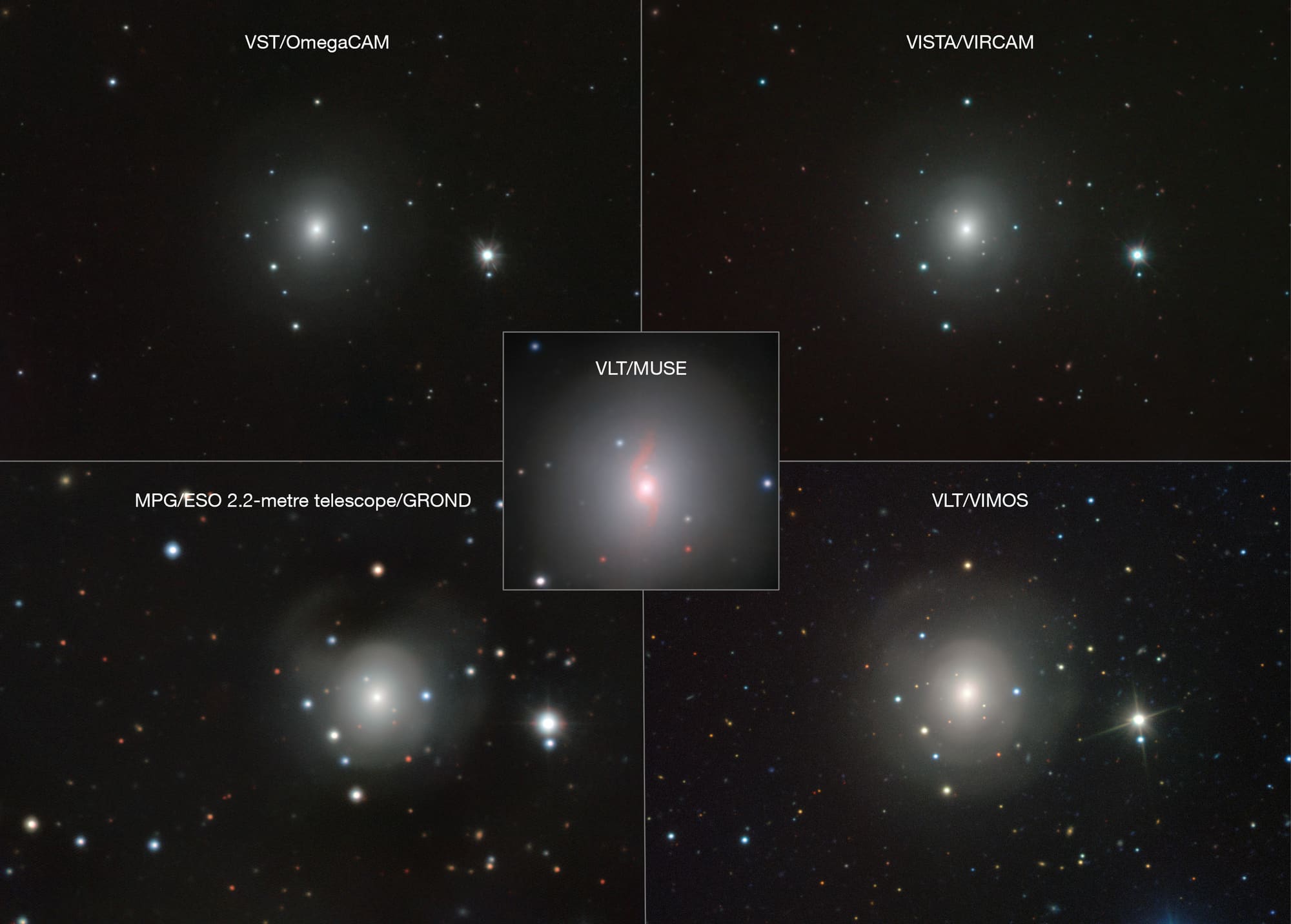
For the first time, a single cosmic event had been heard in gravitational waves and seen across the whole spectrum of light. Astronomers call this multi-messenger astronomy. It solved an old puzzle at a stroke, showing that at least some short gamma-ray bursts come from merging neutron stars.
The glow itself was a kilonova: the radioactive fireball of neutron-rich debris flung out in the collision. Its light carried the fingerprints of freshly forged heavy elements. As NASA has put it, the event showed astronomers that heavy elements found on Earth, such as gold, platinum and uranium, were probably made in kilonovae long ago. The gold in a wedding ring may well have been born in a collision like this, long before the Sun existed.
For the first time, a single cosmic event had been heard in gravitational waves and seen across the whole spectrum of light.
:::note The numbers
- 1916: Einstein predicts gravitational waves (after first doubting them)
- 1993: Nobel Prize for Hulse and Taylor's binary pulsar
- 4 × 10⁻¹⁸ metres: how much LIGO's arms changed length in September 2015
- 1.7 seconds: the gap between the gravitational waves and gamma rays from GW170817
- About 300: significant signals detected during LIGO-Virgo-KAGRA's fourth observing run
- 2.5 million kilometres: the length of each arm of LISA's triangle in space :::
What began as a single chirp has become a steady stream. The first three observing runs, from 2015 to 2020, yielded 90 signals. The fourth, which ran from May 2023 to 18 November 2025 and now included Japan's KAGRA detector, was the longest yet. Its first segment alone produced 128 significant events, bringing the official catalogue to 218 confident detections. With another 173 preliminary candidates from the rest of the run still being analysed, the collaborations count roughly 300 significant signals from that run alone.
The detectors have become so sensitive that they can now pick out fine details. In January 2025 they recorded GW250114, the clearest signal yet, so loud that scientists could hear the newborn black hole "ringing" with more than one tone, as Einstein's theory predicts.
The hum of the galaxy, and beyond
LIGO hears waves whose crests pass in fractions of a second. But the biggest black holes in the universe, millions to billions of times the mass of the Sun, circle each other far more slowly, producing waves with periods of years. To catch those, astronomers have turned the galaxy itself into a detector.
The trick is to use pulsars again: dozens of the steadiest ones, the millisecond pulsars, timed for years by radio telescopes. A gravitational wave washing over the Earth would make some pulsars' ticks arrive a touch early and others a touch late, in a distinctive pattern across the sky worked out in 1983 by Ronald Hellings and George Downs of NASA's Jet Propulsion Laboratory.
At the end of June 2023, pulsar timing teams in North America, Europe, India, Australia and China released coordinated results. The North American NANOGrav collaboration, using 15 years of data on 67 pulsars, reported the first compelling evidence for that telltale correlation, at a significance of around 3.5 to 4 standard deviations. Australia's team used the Parkes radio telescope, known as Murriyang. The signal appears to be a low background hum of gravitational waves, most likely from countless pairs of supermassive black holes across the universe, though more exotic origins are not ruled out.
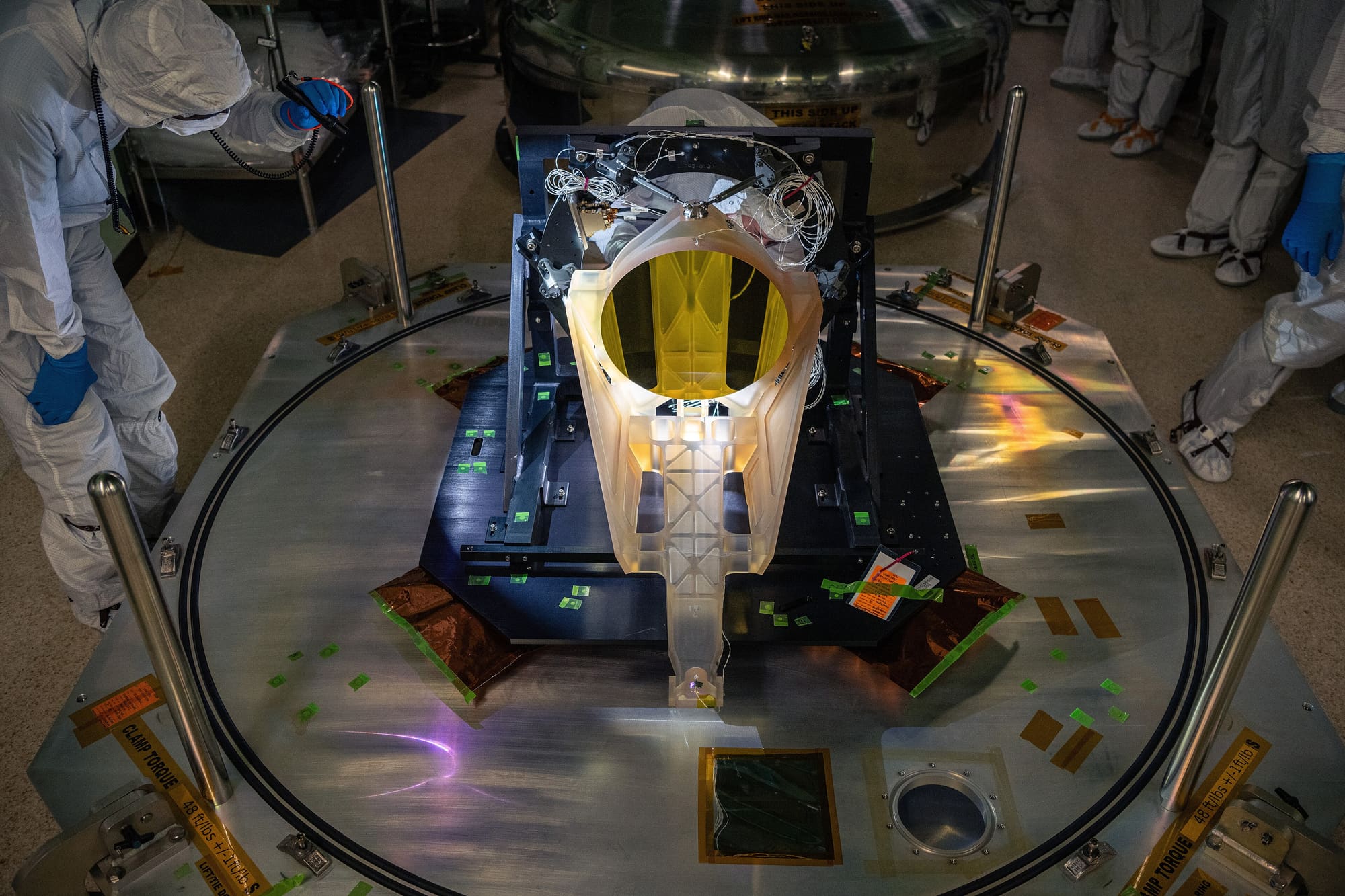
The next leap will be into space. On 25 January 2024 the European Space Agency formally adopted LISA, the Laser Interferometer Space Antenna, giving it the green light to move into construction, with NASA as a partner. LISA will consist of three spacecraft flying in a vast triangle, each side 2.5 million kilometres long, more than six times the distance between the Earth and the Moon. Laser beams passing between them will listen for the waves from merging supermassive black holes and other sources far too slow for ground-based detectors. Launch is planned for 2035 on an Ariane 6 rocket.
It is worth pausing on how far we have come. In 1916 Einstein doubted the waves were real. In 1936 he argued they did not exist. For most of the 20th century they were a theory waiting for a test. Today they are a routine astronomical tool, telling us how black holes are born and grow, how gold is made, and how the largest structures in the universe hum to each other across billions of years.
Astronomy spent most of its history with one sense: sight, extended by telescopes across the spectrum of light. Gravitational waves have given it a second, more like hearing. Some of the universe's most dramatic events, black holes colliding in perfect darkness, give off no light at all. Until 2015 they were silent to us. During the last observing run, a new one arrived every few days.
Sources & further reading
- LIGO Scientific Collaboration and Virgo, "Observation of gravitational waves from a binary black hole merger", arXiv:1602.03837
- LIGO science summary: GW150914, the Advanced LIGO detectors in the era of first discoveries
- Cervantes-Cota, Galindo-Uribarri and Smoot, "A Brief History of Gravitational Waves", arXiv:1609.09400
- Discover: Einstein vs. Physical Review
- Collected Papers of Albert Einstein, Vol. 8: letter to Karl Schwarzschild, 19 February 1916
- APS Physics Focus: A fleeting detection of gravitational waves (Joseph Weber)
- Nobel Prize in Physics 1993: press release
- Nobel Prize in Physics 2017: press release
- LIGO Caltech: GW170817 spawns an explosion of new science
- LIGO-Virgo-KAGRA Collaboration wraps up its fourth observing run
- KAGRA/University of Tokyo: Completion of LIGO-Virgo-KAGRA's fourth observing run
- NASA Fermi: GW170817 and the origin of heavy elements
- Hellings and Downs, "Upper limits on the isotropic gravitational radiation background from pulsar timing analysis", ApJ 265, L39 (1983)
- NANOGrav, "The NANOGrav 15-year data set: evidence for a gravitational-wave background", arXiv:2306.16213
- Reardon et al., "Search for an isotropic gravitational-wave background with the Parkes Pulsar Timing Array", arXiv:2306.16215
- ESA: Capturing the ripples of spacetime, LISA gets go-ahead
- NSF: Arecibo Observatory's 305-meter telescope suffers collapse
Filed under Science. Spotted an error? Tell the editors.