Scientists Are Discovering Something Strange About Dark Energy
For more than a quarter of a century, the force pushing the universe apart was assumed to be utterly constant. A giant galaxy map and a new multi-model analysis suggest it may be changing, and the mystery of how fast the cosmos is expanding refuses to go away.
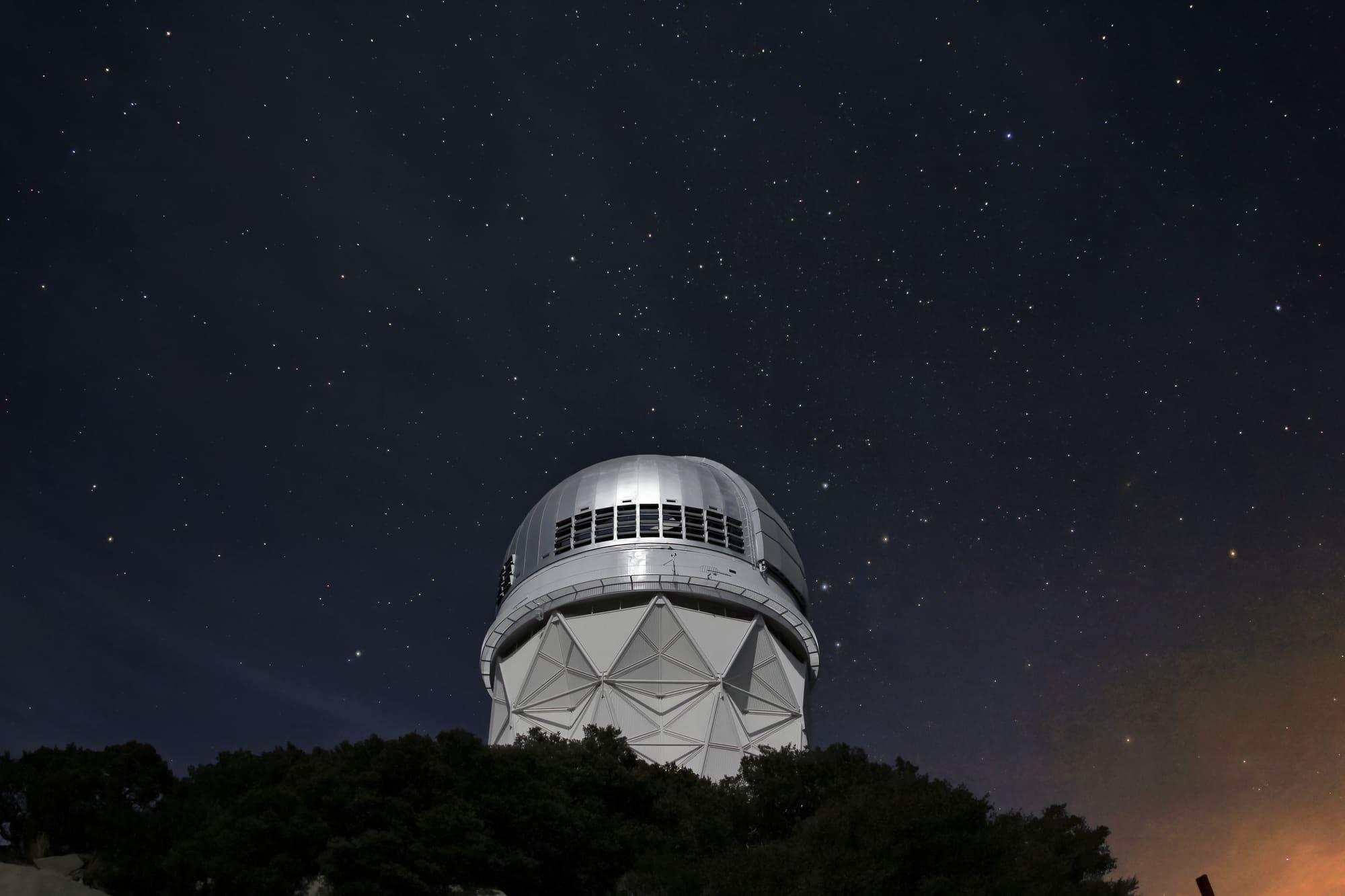
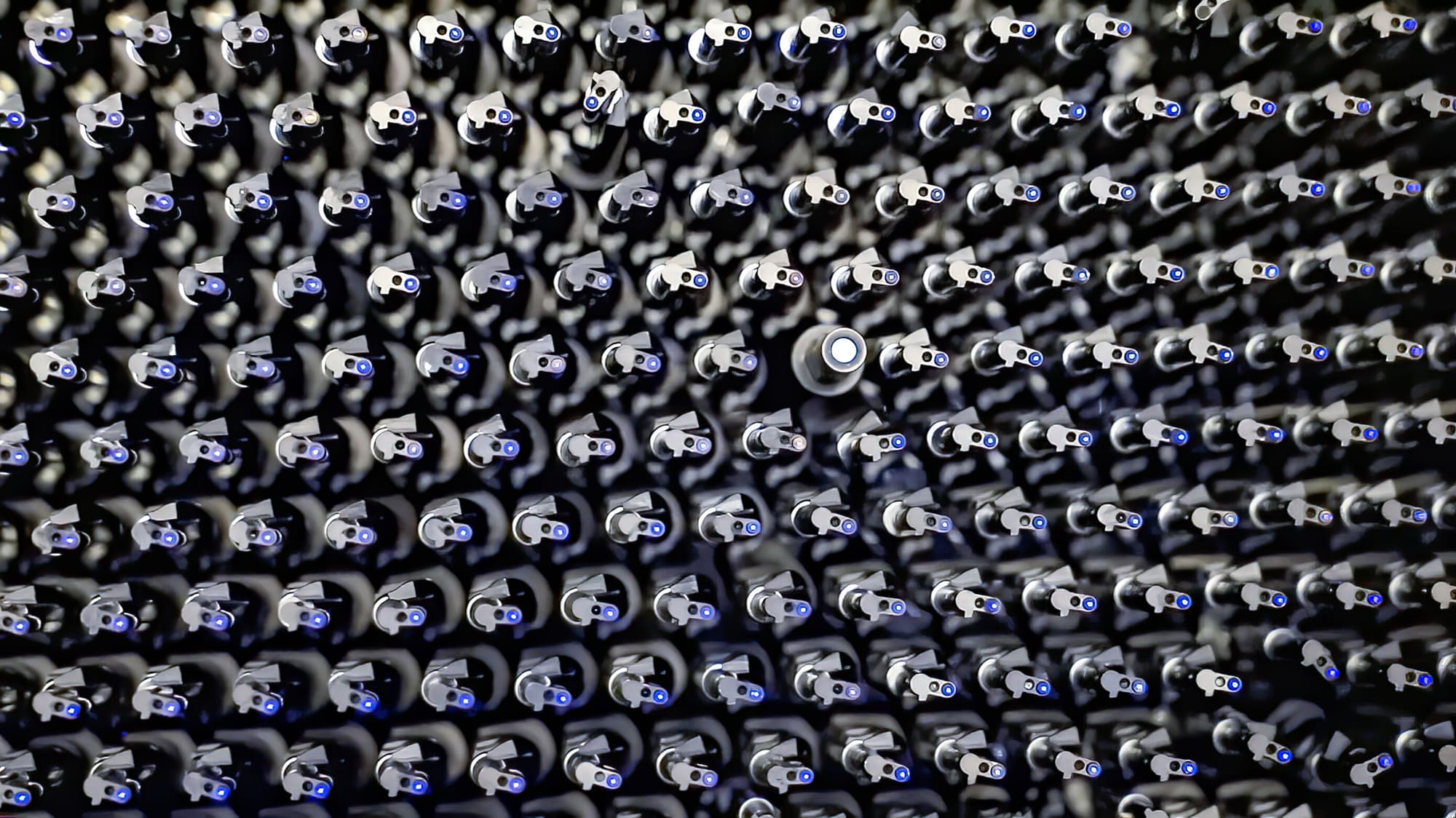
On a mountaintop in the Arizona desert, 5,000 tiny robots spend each clear night swivelling in unison. Each one steers an optical fibre on to a single distant galaxy, and together they gather light that set out as much as 11 billion years ago. Their job is to answer what may be the largest question in physics: what is pushing the universe apart?
The usual answer has been reassuringly dull. Since the late 1990s, when astronomers discovered that cosmic expansion is speeding up, the standard picture has blamed a "cosmological constant": a fixed amount of energy woven into empty space, the same everywhere and at all times. It makes up most of the cosmos and, as far as anyone could tell, never changes.
That dullness is now under strain. The robots belong to the Dark Energy Spectroscopic Instrument, DESI, and their data hint that dark energy may be evolving. A new study from China, published in The Astrophysical Journal, puts five rival ideas to the test and reaches a provocative conclusion.
A ruler written in sound
DESI's method is wonderfully indirect. In the infant universe, before atoms formed, matter and light were locked together in a hot plasma through which sound waves rippled outwards. When the cosmos cooled enough for atoms to form, a few hundred thousand years after the Big Bang, those waves froze in place. Their imprint survives today as a slight preference for galaxies to sit about 500 million light years apart.
Astronomers call this pattern baryon acoustic oscillations, and it works as a cosmic ruler. Because its true length is known, measuring how large it appears at different distances, and therefore different epochs, reveals how fast the universe was expanding at each stage of its history.
DESI sits on the Nicholas U. Mayall 4-metre Telescope at Kitt Peak National Observatory. In April 2024 its first year of data, covering more than 6 million galaxies and quasars, already looked odd. Combined with other measurements, it disfavoured a pure cosmological constant at between 2.5 and 3.9 sigma, depending on which supernova catalogue was added. In March 2025 the second data release, three years of observations covering more than 14 million galaxies and quasars, strengthened the hint: 3.1 sigma with the cosmic microwave background alone, and between 2.8 and 4.2 sigma once supernovae were included.
Physicists usually wait for 5 sigma before claiming a discovery, so this is not yet proof. But the direction is consistent. In the language of cosmologists, the data prefer a value of the parameter w0 a little above minus one and a negative wa. Translated: dark energy appears to be weakening today, after behaving rather differently in the past.
Five ways to build a universe
This is where the new paper comes in. Zhuoming Zhang and Yun Chen of the National Astronomical Observatories of the Chinese Academy of Sciences in Beijing, with Tengpeng Xu of Sun Yat-sen University, set out to ask whether the DESI hint survives when you try several different descriptions of dark energy rather than just one.
They pitted five models against each other. The standard model, with its constant. A version where dark energy has a fixed but adjustable strength. The flexible w0wa model favoured by DESI. A physically motivated model in which dark energy is a slowly rolling field, a bit like a ball easing down a gentle slope. And an "interacting" model in which dark energy and matter can trade energy.
Each model was confronted with four combinations of the best available data: DESI's second-release distance measurements, 1,550 Type Ia supernovae from the Pantheon+ catalogue, and microwave-background observations from the Planck satellite with lensing data from the Atacama Cosmology Telescope. Using nested sampling, a technique that weighs not only how well a model fits but how much complexity it needs to do so, they computed the Bayesian evidence for each.
:::note How the study worked
- Models tested: five, from the standard cosmological constant to interacting dark energy
- Data: 13 DESI DR2 distance measurements, Pantheon+ supernovae, Planck 2018 and ACT DR6 microwave-background and lensing data
- Model ranking: shifts with the data used; no rival decisively beats the standard model across every combination
- Expansion rate: every well-constrained case lands near the low, early-universe value of about 67 km/s/Mpc
- Journal: The Astrophysical Journal, 2026 (arXiv:2512.07281) :::
A universe that changed its mind
The first finding is a sobering one. The winning model depends on which data you feed it. The microwave background alone prefers one alternative, adding DESI favours the w0wa model, adding supernovae swings support back to the standard model, and a fourth combination favours the interacting model. No alternative earns decisive evidence over the cosmological constant across the board.
Yet when the authors looked at how dark energy's behaviour changes with time, a pattern emerged that cut across the models. The early-universe data, from the microwave background, prefer what physicists call a "phantom" phase, in which dark energy's equation-of-state parameter, w, dips below minus one and its density would actually grow as space expands. The late-universe data, from DESI and the supernovae, pull the other way, towards "quintessence", with w above minus one, a dark energy that slowly fades.
In the w0wa model this shows up as a crossing of the so-called phantom divide: phantom-like long ago, quintessence-like today. With one data combination, three of the models excluded a pure cosmological constant at the present day at the 68 per cent confidence level. The authors conclude that dark energy evolves with cosmic time, while acknowledging that Bayesian model comparison does not yet decisively favour any rival to the standard picture.
Dark energy may have spent billions of years behaving one way, then quietly changed character.
There is a further twist. In the interacting model, the full dataset favoured, at 68 per cent confidence, a negative coupling, meaning energy flowing from dark energy into matter in the recent universe. The authors call this tentative but notable, and it chimes with several independent studies.
The tension that will not go away
The paper's other target is the Hubble tension, a long-running argument over how fast the universe is expanding now. Measurements based on the microwave background give about 67.4 kilometres per second per megaparsec. The SH0ES team, who build a distance ladder from pulsating Cepheid stars in nearby galaxies, find about 73.0. Both have small error bars. Both cannot be right.
A changing dark energy has been floated as a possible peacemaker. Here the new study is blunt. With some data combinations, two models nudged the expansion rate upwards and eased the disagreement with SH0ES to 3.5 and 3.8 sigma. But the effect was fragile. Add the supernovae, or swap the full microwave-background data for a simpler prior, and the answer slid back towards 67. Across every well-constrained case, none of the five models reached the local value.
That leaves two uncomfortable options, the authors write: unrecognised errors in one or more measurements, or new physics beyond anything they tested. Evolving dark energy, on this evidence, may be real, but it is not the thing that fixes the Hubble tension.
It is a strange position for cosmology to be in. The standard model still fits remarkably well, yet its two great pillars, a constant dark energy and a single agreed expansion rate, are both wobbling. DESI's full survey, aiming at about 50 million galaxies and quasars, should tell us whether the wobble is the universe or the instruments. Either way, the dull answer is no longer the safe one.
Sources & further reading
- Zhang, Xu & Chen, "Dynamical Dark Energy and the Unresolved Hubble Tension: Multi-model Constraints from DESI 2025 and Other Probes", arXiv:2512.07281 (The Astrophysical Journal, 2026)
- DESI Collaboration, "DESI DR2 Results II: Measurements of Baryon Acoustic Oscillations and Cosmological Constraints", arXiv:2503.14738
- DESI Collaboration, "DESI 2024 VI: Cosmological Constraints from the Measurements of Baryon Acoustic Oscillations", arXiv:2404.03002
- EurekAlert! / University of Texas at Dallas: New DESI results strengthen hints that dark energy may evolve (March 2025)
- UC Berkeley Space Sciences Laboratory: Dark energy results from the first year of DESI operations
- DESI: The DESI science mission
Filed under Science. Spotted an error? Tell the editors.