What Happens When Two Black Holes Collide?
In a fraction of a second, two dark giants become one and turn the mass of several suns into pure trembling of space. Here is how it unfolds, and what three remarkable signals have taught us.
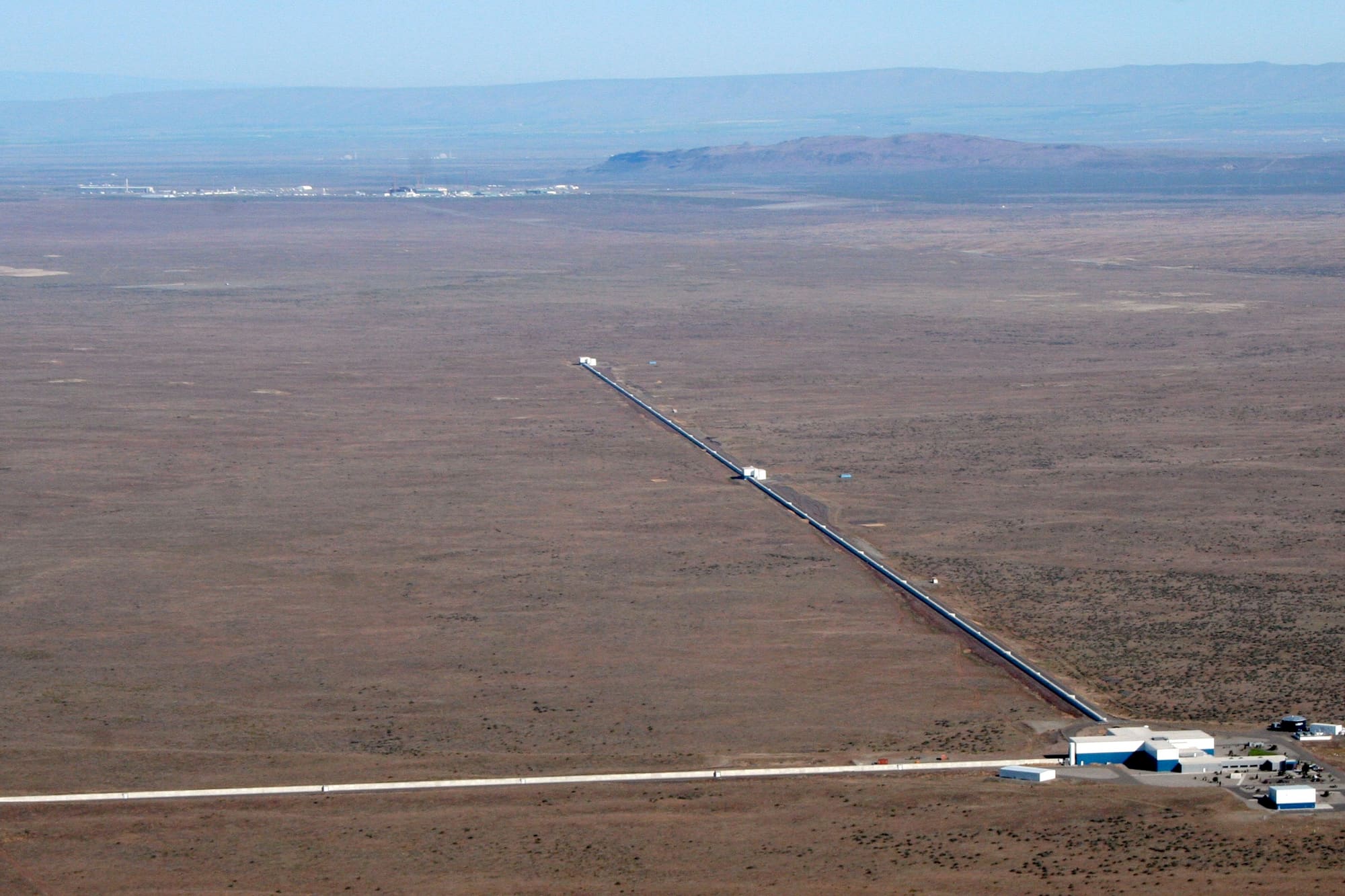
At 09:50:45 GMT on 14 September 2015, a pair of instruments in Louisiana and Washington State registered a stretch and squeeze of space far smaller than the width of a proton. The twitch lasted about a fifth of a second. It had been travelling towards us for 1.3 billion years.
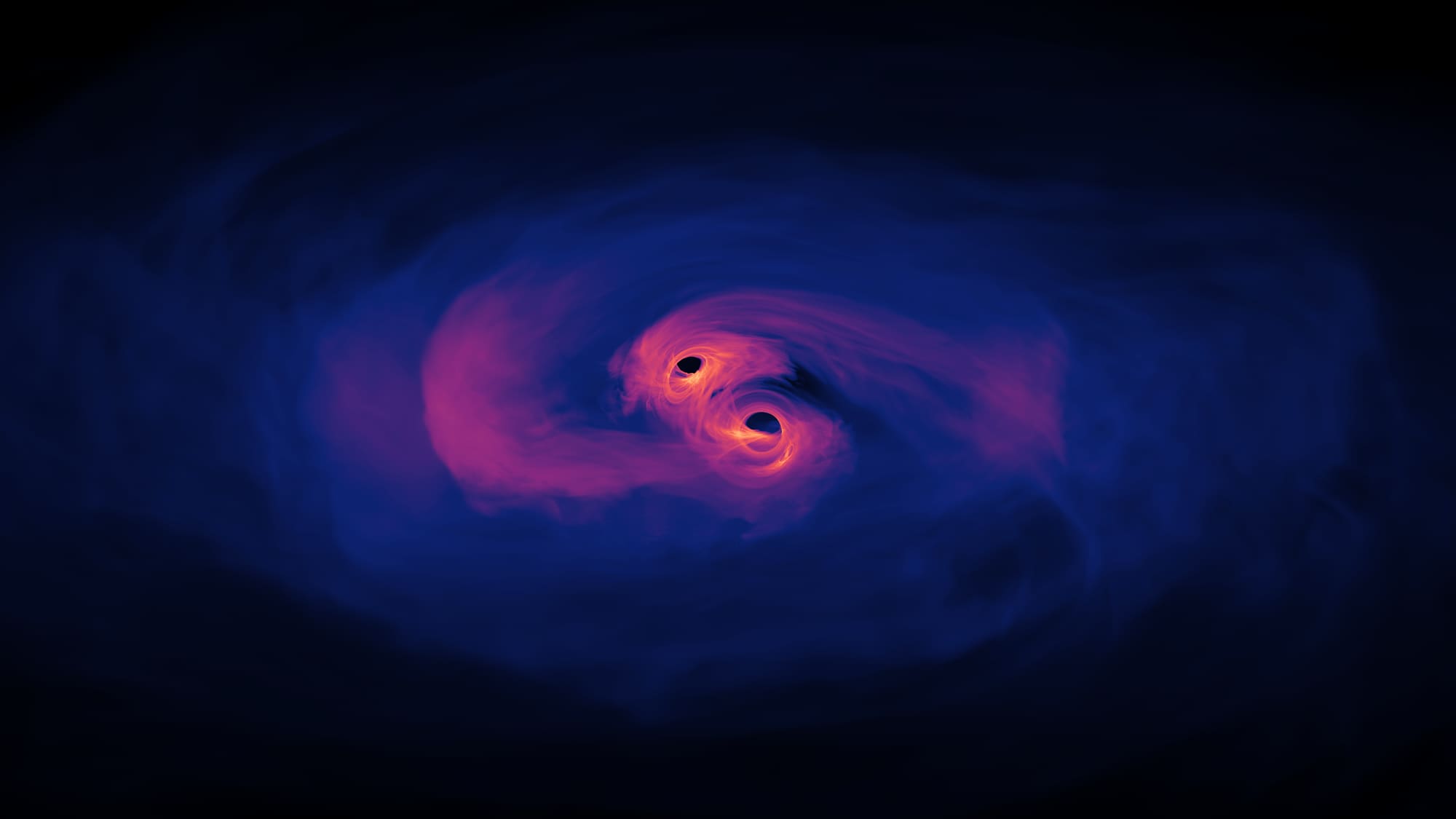
What it recorded was the end of a long marriage: two black holes, one about 36 times the mass of the Sun and the other about 29, spiralling together and merging into one. In the final instant, roughly three Suns' worth of mass simply vanished from the scales, converted into gravitational waves. For a brief moment, according to the LIGO team, that collision outshone the combined power of every star in the visible universe by a factor of about 50. It made no light at all.
So what actually happens when two black holes meet? Physicists describe it in three acts.
The long goodbye
The first act, the inspiral, can last for millions or billions of years. Einstein's general relativity says that accelerating masses stir up ripples in space-time, and two black holes whirling around each other are very accelerated masses indeed. Each orbit radiates a little energy away, so the pair draws a little closer, orbits a little faster, and radiates a little more.
A slow drain becomes a whirlpool. In the final minutes the orbit tightens dramatically, and in the last fraction of a second the two black holes are circling each other scores of times a second. This is why astronomers call the signal a "chirp". For the 2015 event, catalogued as GW150914, the wave swept upwards from 35 to 250 cycles per second in the detectors, much as a bird's call slides up in pitch. Converted to sound, it really does sound like a chirp.
How fast that pitch climbs depends mainly on the masses involved, which is how L-shaped instruments with four-kilometre arms can weigh objects a billion light years away.
Two become one
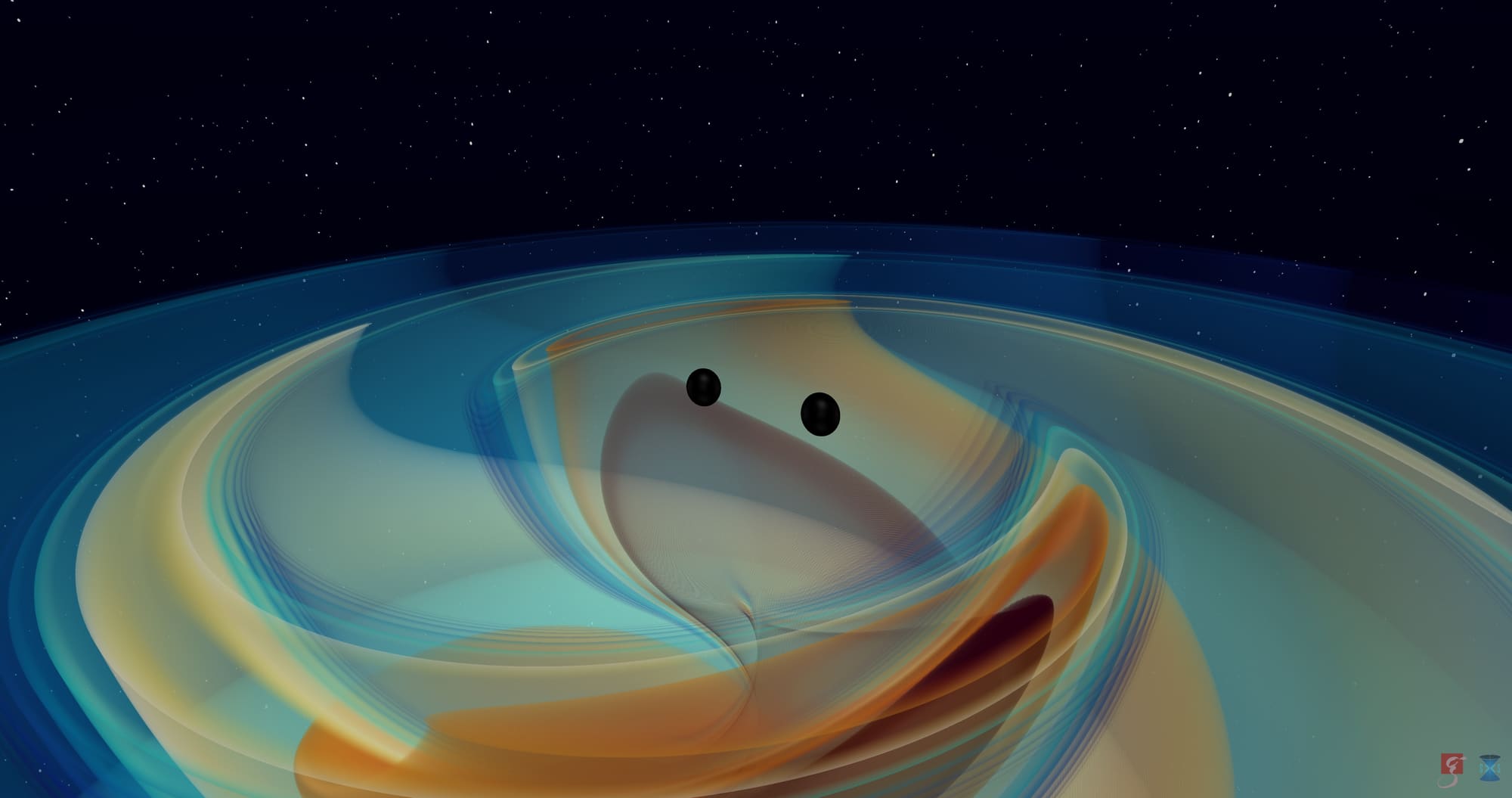
The second act, the merger, is the part no telescope can see and no human intuition can quite grasp. The two event horizons touch and fuse into a single, distorted horizon. According to LIGO's description of GW150914, the black holes were moving at nearly half the speed of light when they met.
The arithmetic is strange. Thirty-six plus 29 makes 65, yet the black hole left behind weighed about 62 solar masses. The missing three went into gravitational waves, following Einstein's E = mc², in what remains one of the most violent energy releases ever measured.
There is no flash and no fireball. Two black holes in a clean vacuum have nothing to burn, so everything is written in the geometry of space itself.
A bell that rings once
The third act is the ringdown. The newborn black hole is lopsided, and nature dislikes a lopsided black hole. It quivers, shedding its distortions as a final burst of gravitational waves that fades within milliseconds, rather like a struck bell falling silent. What remains is the simplest object in physics: a black hole described entirely by its mass and its spin.
Because those fading tones depend only on the final mass and spin, they offer a direct test of whether the remnant is the smooth, spinning object that general relativity predicts.
The black hole that should not exist
If GW150914 proved that merging black holes are real, GW190521 showed how strange their family can be. Detected on 21 May 2019 by the two LIGO detectors and Virgo in Italy, the signal was startlingly brief: less than a tenth of a second, about four short wiggles. Heavy pairs merge at low frequencies, so little of their chirp falls within the detectors' hearing.
The two black holes weighed about 85 and 66 solar masses. Their merger produced a black hole of about 142 solar masses and released energy equivalent to about eight Suns. The source lay roughly five gigaparsecs away, so the waves set out when the universe was about half its present age.
Both numbers were puzzles. The final black hole was the first clear detection of an "intermediate-mass" black hole, between about 100 and 1,000 Suns. And the larger of the two progenitors sat in what theorists call the pair-instability mass gap. Stars that grow very heavy become unstable in their cores, and the theory says they should blow themselves apart completely rather than leave a black hole between about 65 and 120 solar masses. One way out, which the team considered, is a hierarchical merger: the 85-solar-mass black hole may itself have been the product of an earlier collision. Black holes, it seems, can be built from other black holes.
:::note The numbers
- GW150914 (2015): about 36 and 29 solar masses, final black hole about 62, roughly 3 solar masses radiated as gravitational waves
- GW190521 (2019): about 85 and 66 solar masses, final black hole about 142, roughly 8 solar masses radiated
- GW250114 (2025): about 33.6 and 32.2 solar masses, recorded with a signal-to-noise ratio of 80, against 24 for the first detection
- Horizon area, GW250114: about 240,000 square kilometres before the merger and about 400,000 after
- Detection rate: roughly one signal a month a decade ago, about one every three days now :::
Hearing Hawking's rule
On 14 January 2025, a signal arrived that looked uncannily like an old friend. GW250114 came from two black holes of about 33.6 and 32.2 solar masses, also about 1.3 billion light years away, very much like the 2015 pair. The difference was in the instruments. A decade of work to hush the detectors had made them nearly four times as sensitive, and the new signal stood out from the noise with a signal-to-noise ratio of 80. Katerina Chatziioannou of Caltech put it simply in the LIGO announcement: "We can hear it loud and clear, and that lets us test the fundamental laws of physics."
The law in question was Stephen Hawking's. In 1971 he proposed that the total surface area of black hole event horizons can never decrease. That is not obvious in a merger. The masses combine, which enlarges the horizon, but energy is lost to gravitational waves and the remnant spins faster, and both effects tend to shrink it. Hawking's theorem says the growth must always win.
Two black holes with a combined horizon the size of Oregon became one the size of California, and Hawking's arithmetic held.
To check, the team measured the horizon areas before the merger from the inspiral, and the area afterwards from the ringdown. For the first time they could confidently pick out two distinct tones in the ringing, which pinned down the final mass and spin and matched the predictions of Saul Teukolsky's 1972 mathematics. The verdict, published in Physical Review Letters in September 2025: a total horizon area of about 240,000 square kilometres beforehand, roughly the size of Oregon, and about 400,000 afterwards, roughly the size of California. An earlier test using the 2015 data had reached 95 per cent confidence; the new one reached 99.999 per cent.
Hawking died in 2018, three years after the first detection. Kip Thorne recalled that Hawking had phoned him almost immediately to ask whether LIGO could test the theorem. "If Hawking were alive, he would have reveled in seeing the area of the merged black holes increase," Thorne said.
That is the loveliest thing about colliding black holes. They are the darkest events in the cosmos, and yet by listening carefully we can weigh them, clock their spin and even measure their surfaces from more than a billion light years away.
Sources & further reading
- LIGO Caltech: Gravitational waves detected 100 years after Einstein's prediction (2016)
- LIGO Scientific Collaboration and Virgo Collaboration, "Observation of Gravitational Waves from a Binary Black Hole Merger", Physical Review Letters (arXiv:1602.03837)
- LIGO Caltech: A "bang" in LIGO and Virgo detectors signals most massive gravitational-wave source yet (GW190521)
- LIGO Caltech: LIGO and its partners celebrate anniversary, announce verification of Stephen Hawking's black hole area theorem (GW250114)
- American Physical Society: Clearest signal yet confirms Hawking's area theorem
- LIGO-Virgo-KAGRA Collaboration, "GW250114: Testing Hawking's Area Law and the Kerr Nature of Black Holes", Physical Review Letters 135, 111403 (2025)
Filed under Science. Spotted an error? Tell the editors.