The Hidden World of Sound: Frequencies, Vibrations and the Human Ear
Elephants rumble below our hearing, bats shout above it, and blue whales have been singing steadily lower for sixty years. A tour of the sounds we cannot hear, and of the remarkable organ that hears the rest.

In 1984 the acoustic biologist Katy Payne visited the zoo in Portland, Oregon, to give a talk about whales. She lingered by the elephant enclosure, and every now and then she felt a throbbing in the air. She could feel it, but she could not hear it.
When she and her colleagues later recorded the elephants with equipment that could capture very low frequencies, the throbbing turned out to be calls. They were real, structured and largely below the range of human hearing. It was a reminder that the world is full of sound we never notice, and that our own ears tune in to only one band of a much wider spectrum.
What a sound actually is
Sound is a travelling squeeze. A vibrating object, whether a vocal cord, a guitar string or an elephant's larynx, pushes on the air next to it. That air pushes on its neighbours, and a pattern of tiny compressions and rarefactions ripples outward. The air itself barely moves. The pattern is what travels, at about 344 metres per second in air at 20°C and roughly 1,500 metres per second in seawater.
Two numbers describe most of what we hear. Amplitude, the size of the pressure swings, we experience as loudness. Frequency, the number of swings per second measured in hertz, we experience as pitch. Frequency also sets the length of each wave. A 20 Hz rumble in air has waves about 17 metres long, longer than a double-decker bus. A 20,000 Hz whine has waves under 2 centimetres long. Young, healthy human ears span roughly 20 Hz to 20,000 Hz, about ten octaves. Below that range is infrasound, and above it is ultrasound.
Below the floor: elephants and whales
Long waves travel far. They bend around obstacles and lose relatively little energy along the way, which makes infrasound ideal for keeping in touch across great distances. In 1986 Payne, William Langbauer and Elizabeth Marshall Thomas published the zoo recordings in Behavioral Ecology and Sociobiology. Most of the Asian elephants' calls lay between 14 and 24 Hz and lasted 10 to 15 seconds. They were the first infrasonic calls reported from a land mammal.
Later work in Kenya showed what these rumbles carry. In playback experiments in Amboseli National Park, Karen McComb and colleagues found that adult female African elephants could tell the contact calls of their own family from those of other families. The researchers estimated that each female must know the voices of around 14 families in the population.

In the ocean, the great whales go lower still. Blue whale songs sit in a band of roughly 10 to 40 Hz, at or just below the bottom of human hearing. In 2009 Mark McDonald, John Hildebrand and Sarah Mesnick, working with Scripps Institution of Oceanography, analysed thousands of songs recorded since the 1960s. They found that all seven song types with enough data had been drifting steadily downwards. Off California, the fundamental tone fell from 21.9 Hz in 1963 to 15.2 Hz in 2008, about 31% lower.
Somewhere beneath the waves, the largest animal that has ever lived has been quietly lowering its voice for sixty years.
The cause is still debated. The authors ruled out warming seas and rising shipping noise as the main explanation. Their intriguing suggestion is that as blue whales recover from whaling, males no longer need to sing so loudly to be heard by a distant mate, and can instead choose a deeper pitch.
Above the ceiling: the bats' secret
At the other extreme, the mystery took 140 years to solve. In the 1790s the Italian priest and naturalist Lazzaro Spallanzani found that blinded bats flew and dodged obstacles as well as sighted ones. The Swiss surgeon Charles Jurine then showed that bats with their ears plugged with wax collided helplessly. Bats seemed to see with their ears, yet they appeared silent.
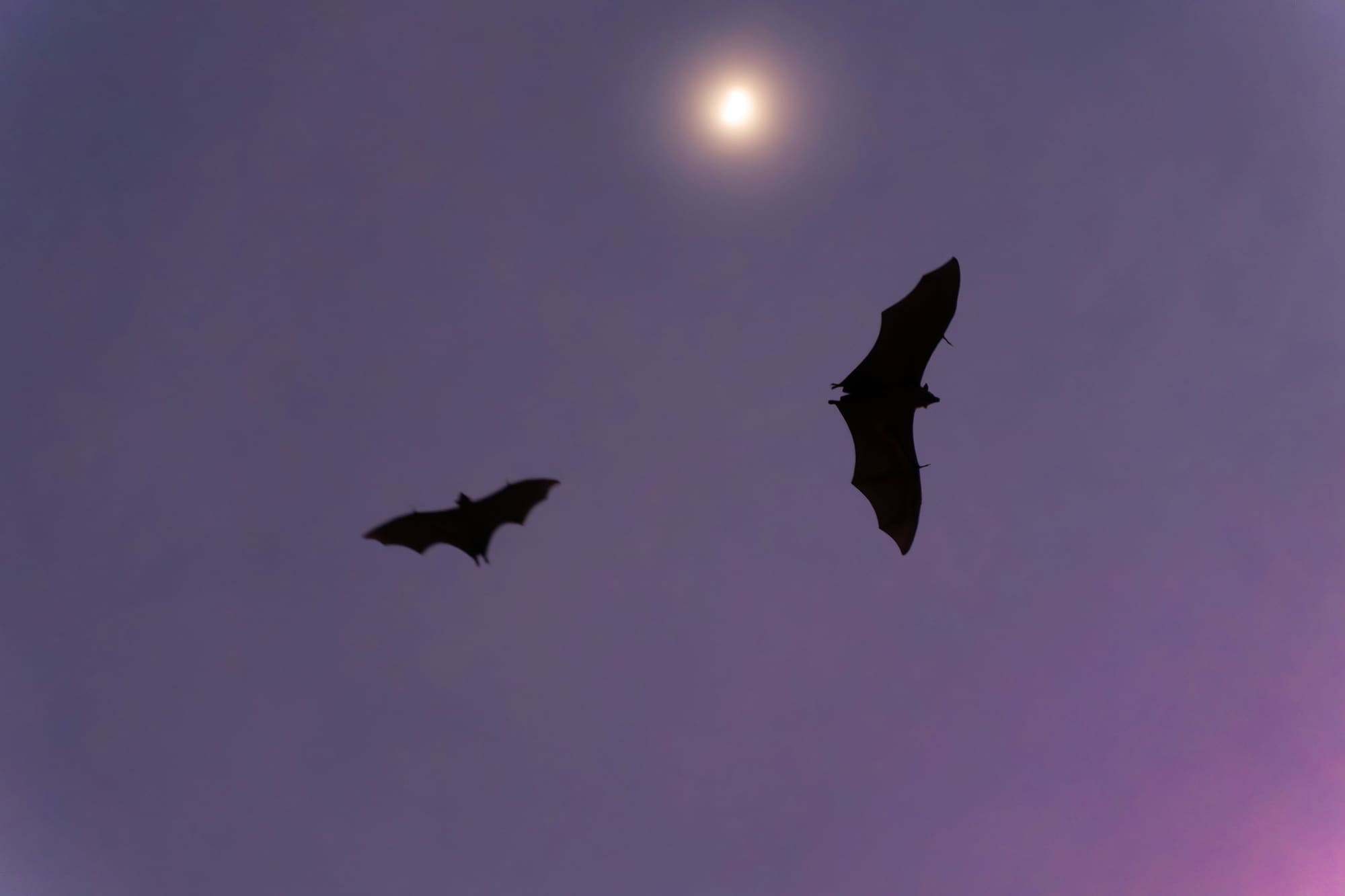
The answer came in 1938, when Donald Griffin, then a Harvard undergraduate, took bats to the physicist G. W. Pierce, who had built a detector for sounds beyond human hearing. The "silent" bats were in fact pouring out intense ultrasonic calls. Griffin and Robert Galambos showed that bats whose mouths were covered or ears blocked crashed into things, and in 1944 Griffin gave the ability its name: echolocation. In Britain alone, calls range from about 20 kHz for the noctule to roughly 110 kHz for the lesser horseshoe bat; the familiar pipistrelle in your garden calls at around 45 to 55 kHz. From the returning echoes, bats can judge an object's distance, size, texture and speed.
:::note The range of hearing
- 14–24 Hz: most infrasonic calls recorded from Asian elephants in 1986
- 15.2 Hz: the fundamental tone of the Californian blue whale song in 2008, down from 21.9 Hz in 1963
- 20 Hz–20 kHz: the range of healthy young human ears
- About 17.4 kHz: a tone many adults over about 25 can no longer hear
- About 110 kHz: the call of the lesser horseshoe bat, among the highest of British bats :::
Counting in decibels
Our ears cover an enormous range of loudness as well as pitch. The threshold of pain carries roughly ten trillion times the intensity of the faintest sound we can detect. To handle such a span, acousticians use the logarithmic decibel scale. Every extra 10 dB means ten times the intensity, and as a rule of thumb it takes about ten times the intensity for a sound to seem twice as loud. The smallest change in level most of us can notice is about 1 dB.
The keyboard in your head
How does one small organ sort all this out? Inside the snail-shaped cochlea, the basilar membrane works as a frequency analyser. Georg von Békésy, who won the 1961 Nobel Prize for the discovery, showed that sound sets up a travelling wave along the membrane. The wave peaks near the stiff base for high notes and near the floppy tip for low ones. A chord, or a voice, is split into its component frequencies along the spiral, and each one is reported to the brain by the hair cells at that spot. It is mechanical frequency analysis, running every second of our lives.
That also explains how hearing tends to fade. The high-frequency end at the base of the cochlea receives the full force of every incoming sound, and it usually wears first. Age-related hearing loss, or presbycusis, typically begins at the top of the range. Many adults over about 25 can no longer hear a 17.4 kHz tone, which is why it has been used as a "teenager-only" ringtone. Over time the loss creeps down into the 2 to 4 kHz region where consonants such as s and f live. In the United States, about one in three people aged 65 to 74 has hearing loss, and nearly half of those over 75 have difficulty hearing. In the UK, RNID puts the figure at almost 80% of people over 70.
The hidden world of sound will stay hidden from us. The part we can hear is worth protecting. If high voices or birdsong have started to fade, ask your GP about a hearing test. Some pharmacies and opticians offer them free.
Sources & further reading
- NPR: To decode elephant conversation, you must feel the jungle rumble
- Payne, K. B., Langbauer, W. R. & Thomas, E. M. (1986). Infrasonic calls of the Asian elephant. Behavioral Ecology and Sociobiology
- McComb, K. et al. (2003). Unusually extensive networks of vocal recognition in African elephants. University of Sussex
- McDonald, M. A., Hildebrand, J. A. & Mesnick, S. (2009). Worldwide decline in tonal frequencies of blue whale songs. Endangered Species Research
- AAAS: Discovering sonar in bats
- Griffin, D. R. (1944). Echolocation by blind men, bats and radar. Science
- London Bat Group: Echolocation and bat detectors
- Bat Conservation Northamptonshire and Cambridgeshire: Key to echolocation calls
- HyperPhysics: The decibel scale and speed of sound
- HyperPhysics: von Békésy and the place theory
- NIDCD: Age-related hearing loss
- RNID: Facts and figures
- NHS: Hearing loss
Filed under Hearing & Sound. Spotted an error? Tell the editors.