How Artificial Intelligence Is Changing Hearing Technology
Deep learning can now pull a voice out of a noisy room better than any filter before it. The hard part is making it fit behind an ear, run on a battery the size of a lentil, and answer in under ten milliseconds.
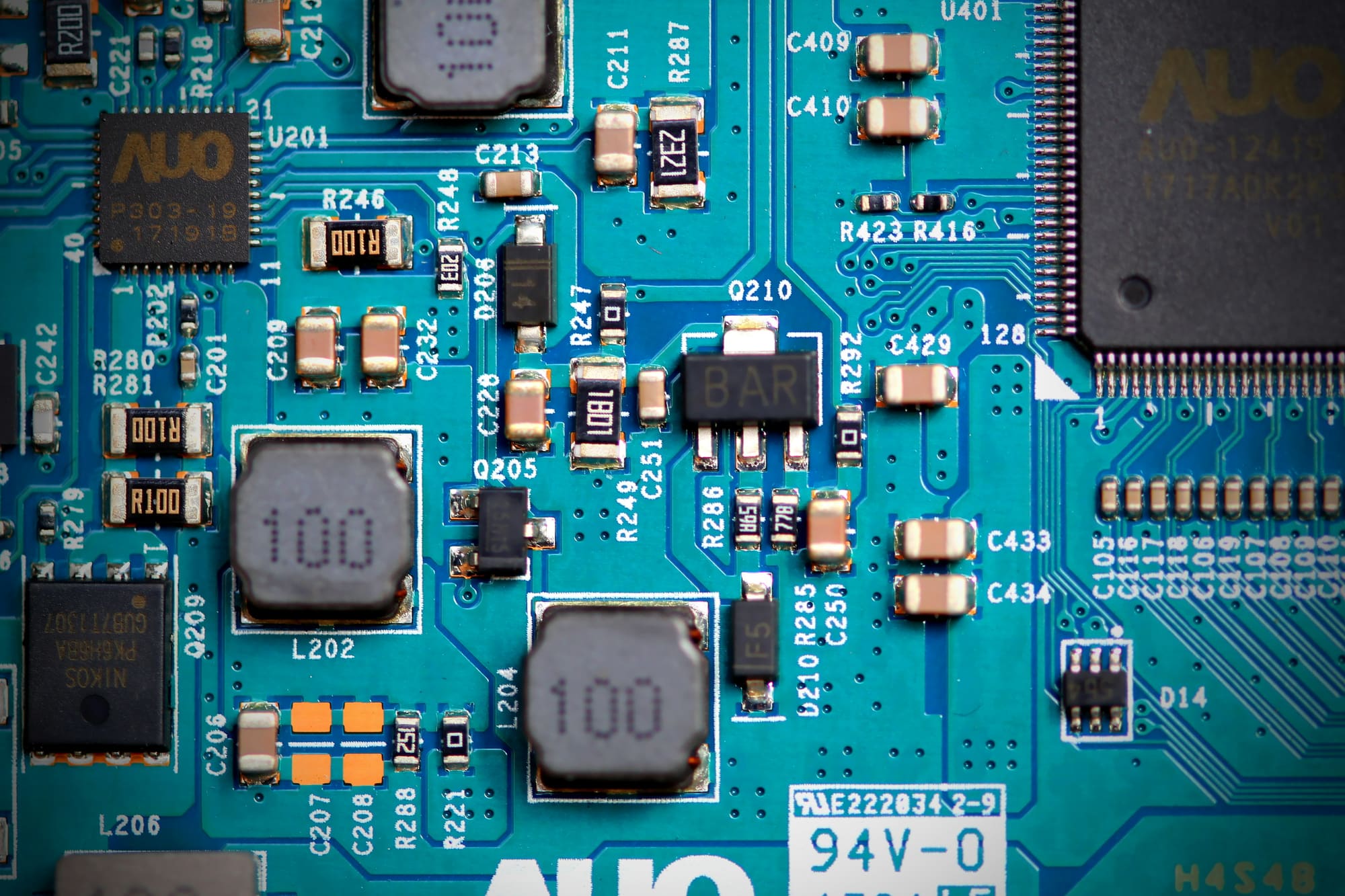
For hearing-aid wearers, the hard places are rarely quiet rooms. They are the birthday meal, the station concourse, the pub on a Friday: places where the voice you want arrives tangled up with a dozen you don't. For decades the industry's best tools could turn the noise down a little. They could not reliably tell a friend's sentence from the clatter around it.
That is what artificial intelligence is now being asked to do. A systematic review posted to arXiv in 2025 by Haris Khan and colleagues at the National University of Sciences and Technology (NUST) in Islamabad gathers a decade of research, from 2015 to 2024, on what it calls selective noise cancellation: keeping the sounds a listener wants and removing the rest. Its conclusions are encouraging and sobering in roughly equal measure.
The stakes are large. The World Health Organization projects that by 2050 nearly 2.5 billion people will have some degree of hearing loss, and more than 700 million will need rehabilitation.
A family tree of listening machines
The NUST team searched IEEE Xplore, PubMed, the ACM Digital Library and Google Scholar, screened papers with two independent reviewers, and graded study quality with an adapted version of QUADAS-2, a standard tool for appraising diagnostic research. What emerges is a family tree with several distinct branches.
At the root sits classical signal processing: spectral subtraction, which estimates the noise and subtracts it; Wiener filtering; adaptive filters; and beamforming, which uses two or more microphones to favour sound from one direction. Alongside it is active noise cancellation, the anti-noise trick familiar from headphones.
Next came classical machine learning: support vector machines to detect speech, and statistical models to classify acoustic scenes.
Then the deep-learning era. Convolutional networks read spectrograms (pictures of sound, with frequency on one axis and time on the other) much as they read photographs. Recurrent networks such as LSTMs and GRUs add memory, so that each moment is interpreted in the light of the last. The review singles out convolutional recurrent networks (CRNs), which combine the two. A design by Ke Tan and DeLiang Wang stacks a five-layer convolutional encoder, two LSTM layers and a five-layer decoder, and uses only past and present sound, never the future, which is essential for anything worn in real time.
At the top of the tree sit transformers, the architecture behind today's chatbots, such as SepFormer, and speaker-aware systems, which try to lock onto one particular voice rather than all speech.
The scoreboard, and its catch
The review pools reported results for each family, and the gradient is striking. Researchers often measure separation using SI-SDR, a score in decibels of how cleanly the target voice is recovered. Traditional processing averages around 8.2 dB. CNN-based models reach about 12.4 dB, LSTMs 14.7 dB, and CRNs 18.3 dB. Transformers top the table at 22.4 dB. Predicted intelligibility (STOI) rises from 0.78 to 0.95.
Then look at the latency column. Conventional processing answers in about 2.1 milliseconds and a CRN in 6.4. The transformer takes 45.2.
That matters because, as the review stresses, hearing devices generally need to respond in under about 10 milliseconds: the processed sound has to keep pace with the world. So the best performer on paper is, for now, the least wearable. CRNs stay inside the limit, and a speaker-aware CRN, reaching 19.8 dB at 6.24 ms, shows the direction of travel.
The best performer on paper is, for now, the least wearable.
A battery the size of a lentil
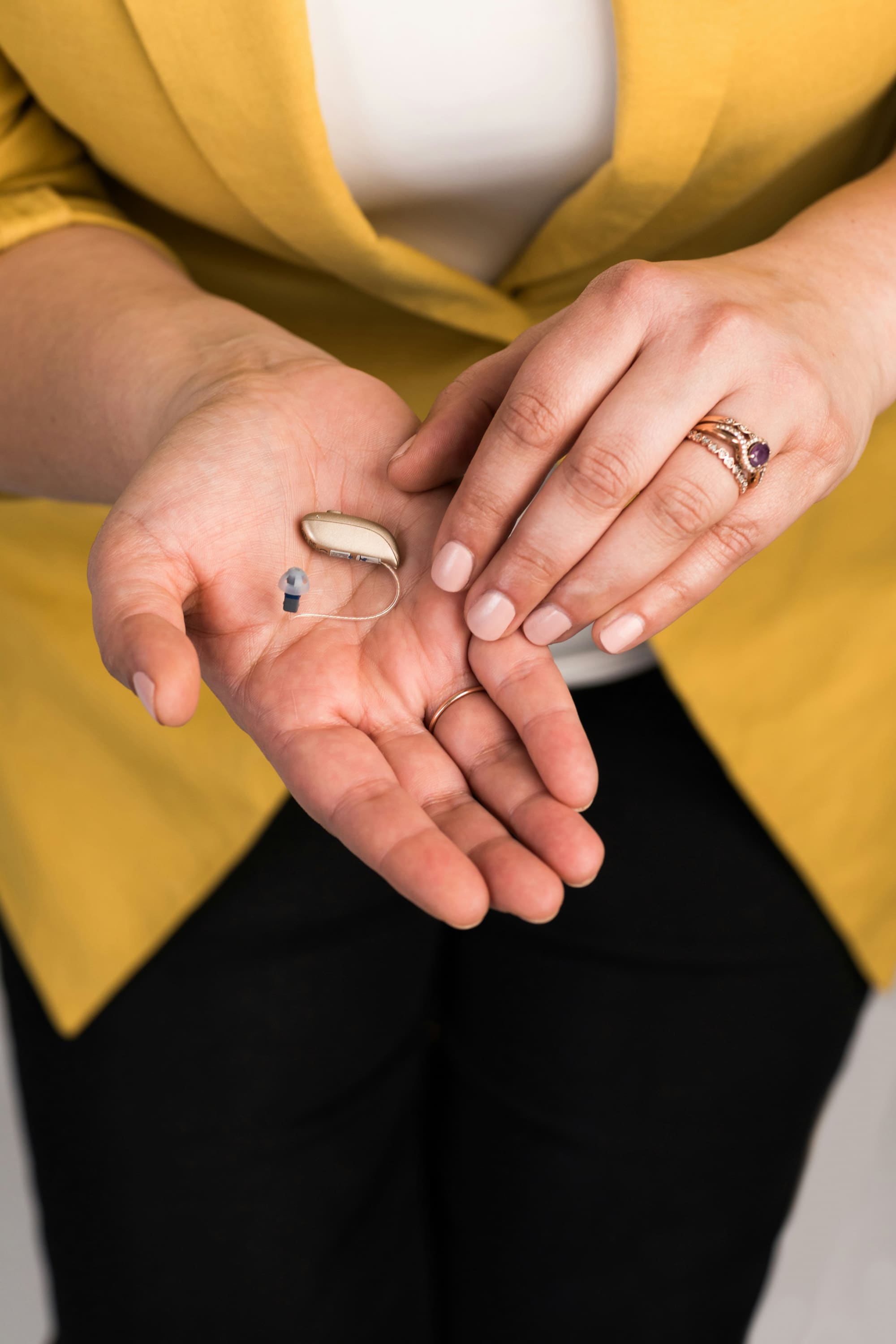
Latency is half the problem. Power is the other half. The review puts a conventional hearing aid's processing budget at roughly one to three milliwatts, with somewhere between 512 kilobytes and 2 megabytes of memory. Deep-learning versions, it reports, can consume 15 to 150 times more. (The review's own tables are not entirely consistent on power figures, a reminder that this is a young field without settled benchmarks.)
The demonstrations so far tell the story. One speaker-aware system by Veluri and colleagues hit 6.24 ms, but on an Orange Pi 5B, a small single-board computer with a dedicated neural processor. A CNN built on an FPGA chip managed 8.5 ms at 78 milliwatts, which is impressive but still dozens of times a hearing aid's usual budget. A striking 2023 study in Scientific Reports, led by Peter Udo Diehl of the Berlin company Audatic with clinicians at the Charité hospital, found that a denoising network brought 16 hearing-aid users' speech understanding in noise close to that of 17 normal-hearing listeners. It ran in real time on a gaming laptop, and the authors acknowledged that it was not yet ready for hearing-aid hardware.
To close the gap, engineers are borrowing every trick available. Quantisation stores a network's numbers in 8 or even 4 bits instead of 32. Pruning removes 50 to 90 per cent of connections. Knowledge distillation trains a small "student" to mimic a large "teacher". And hardware-aware architecture search lets an algorithm design networks to fit a given chip.
:::note The numbers
- Under 10 ms: the delay hearing devices generally need to stay within
- 1–3 mW: typical processing power budget of a conventional hearing aid
- 15–150×: how much more power AI-enhanced processing can draw
- 18.3 dB vs 22.4 dB: separation quality of CRNs vs transformers, at 6.4 ms vs 45.2 ms
- 50–90%: share of a network that pruning can remove :::
What the evidence does and doesn't show
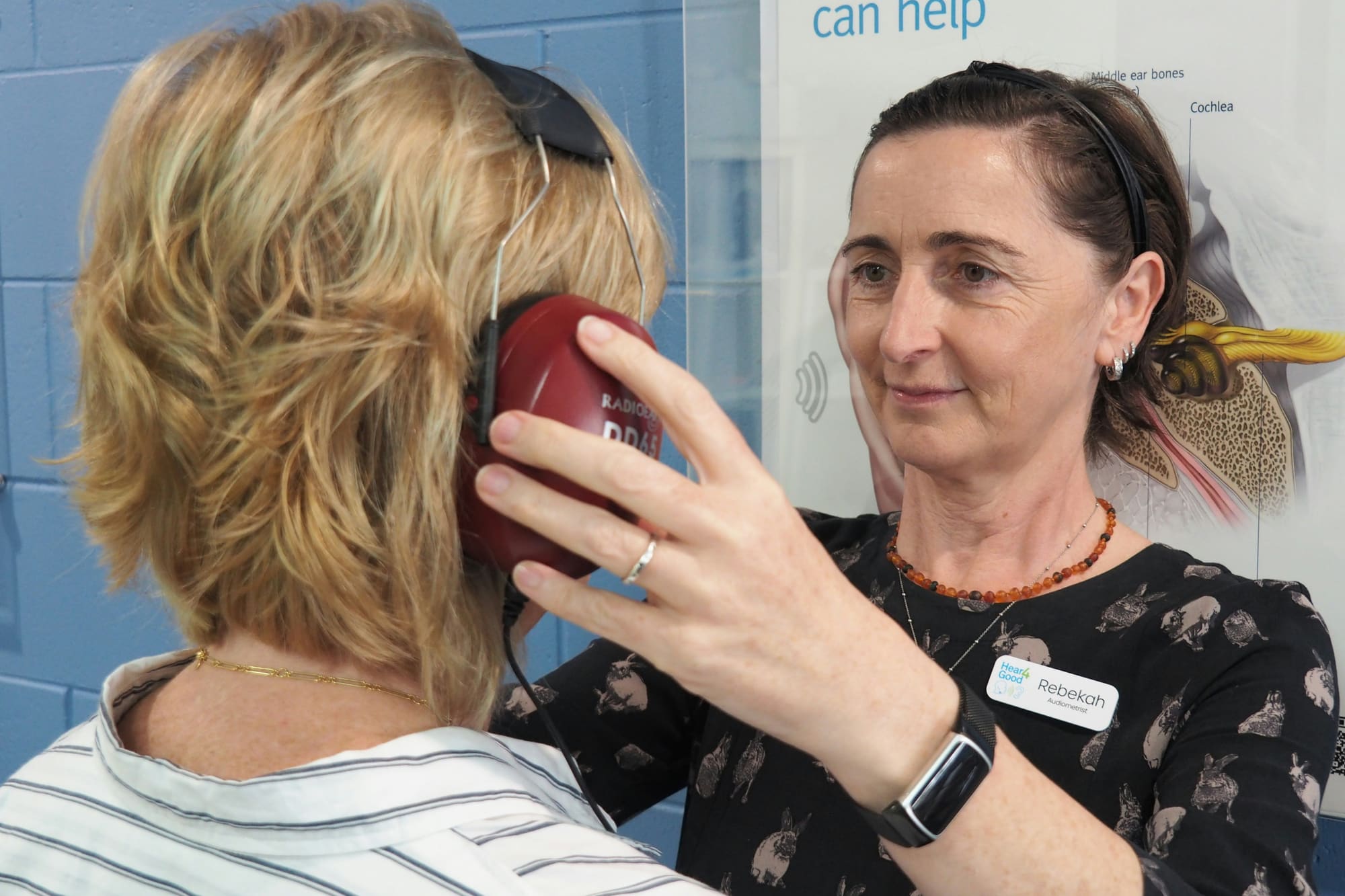
The clinical picture is promising but thin. The review describes randomised controlled trials as the gold standard and recommends crossover designs, in which each participant tries both the new and the old processing. It lists the outcomes that count: speech reception thresholds, word recognition, listening effort and established questionnaires such as APHAB. Yet the studies it cites come with few details of sample size, and it does not pool their effects.
The authors also consider who will use these devices. Speech understanding matters most, followed by reduced listening effort and social confidence. Preferences vary with age: people under 50 tend to want smartphone control, while those over 70 prefer devices that simply work automatically.
The unsolved problems
The review's list of challenges is refreshingly candid. Models trained in the laboratory often stumble in real rooms, with overlapping talkers, unfamiliar noises and reverberation. Speaker-aware systems often need an explicit "enrolment" step to learn the target voice, which is impractical in daily life. Power budgets are exceeded by orders of magnitude. There is no standard evaluation protocol, which makes it hard to compare systems fairly. Few devices learn from their wearer's feedback over time. And a device that is always listening raises real questions about privacy and security.
The recommended next steps follow directly: lightweight and compressed models, continual learning that adapts to a wearer's world, scene classifiers that recognise whether you are in a café or a car, and the fusion of classic beamforming with deep target-speaker detection. Further out, the authors suggest adding other signals, such as head movement and visual cues, to help decide whose voice matters. They also call for low-cost, open-source approaches so that these gains do not reach only the wealthy.
The goal, in other words, is not a hearing aid that hears more. It is one that listens the way a person does: choosing. If you have noticed conversations becoming harder to follow, your GP or an audiologist is the right first stop. The technology is improving, but it starts with a hearing test.
Sources & further reading
- Khan et al., "Advances in Intelligent Hearing Aids: Deep Learning Approaches to Selective Noise Cancellation", arXiv:2507.07043
- Full HTML text of the review on arXiv
- Diehl et al., "Restoring speech intelligibility for hearing aid users with deep learning", Scientific Reports (2023)
- World Health Organization: Deafness and hearing loss fact sheet
- WHO: 1 in 4 people projected to have hearing problems by 2050
Filed under Hearing & Sound. Spotted an error? Tell the editors.